

Yo, what's up! I'm stoked to share with you the history of acoustic diffusers. As a supplier of link text: Solid Wood Sound Diffuser, link text: Qrd Sound Diffuser, and link text: Diffuser Sound Absorber, I've got a deep interest in these nifty devices, and I think their backstory is pretty fascinating.
Let's start way back in the day. The concept of sound diffusion isn't something brand - new. It actually has roots in the early days of architecture and acoustics. Ancient Greeks were onto something when they designed their amphitheaters. They didn't have fancy acoustic diffusers like we do now, but they used the natural shape of the seating and the surrounding structures to disperse sound. The stepped seating in these amphitheaters helped to scatter sound waves, making it possible for people sitting far away to still hear the performances clearly. It was a basic form of sound diffusion, and it was super effective for its time.
Fast forward to the 20th century, and things really started to heat up in the world of acoustic diffusers. In the 1970s, a guy named Manfred R. Schroeder came up with a game - changing idea. He developed the Quadratic Residue Diffuser (QRD). This was a major breakthrough. The QRD uses a series of wells or grooves of different depths to scatter sound waves in a very controlled way. The pattern of these wells is based on a mathematical formula, which ensures that the sound is diffused evenly across a wide range of frequencies. This was a huge step forward because before the QRD, diffusing sound across different frequencies was a real challenge.
The design of the QRD was a bit of a departure from the traditional sound - absorbing materials that were commonly used at the time. Instead of just soaking up sound, like a sponge, the QRD redirected it. This was great for places like recording studios, concert halls, and theaters. In a recording studio, for example, sound absorption alone can make the space sound dead and lifeless. But with a QRD, the sound can bounce around in a more natural way, creating a more pleasant and realistic listening environment.
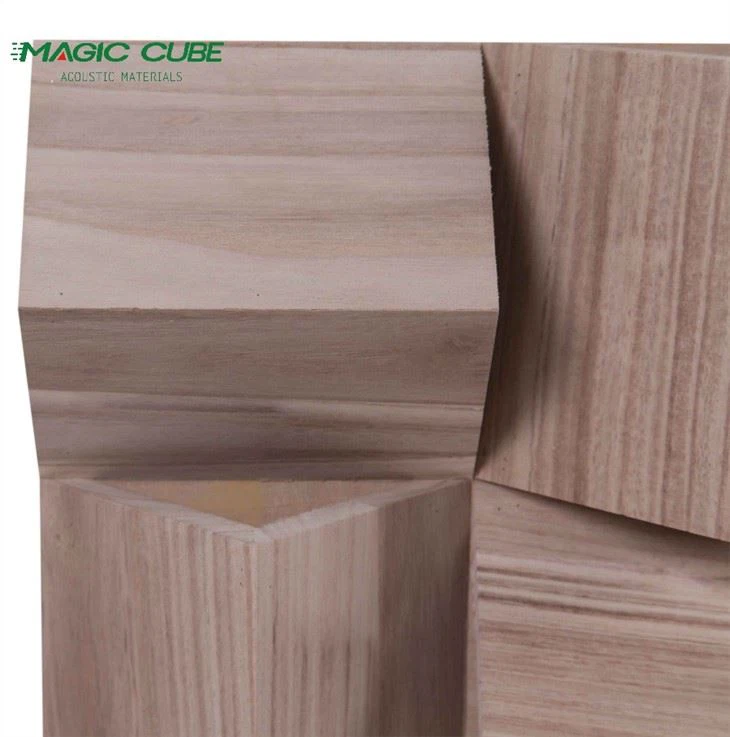

As the years went by, other types of diffusers started to emerge. There were linear diffusers, which are long, narrow devices that are great for treating specific areas, like along the walls of a room. And there were also two - dimensional diffusers, which can scatter sound in multiple directions, providing even more comprehensive sound diffusion.
The materials used to make acoustic diffusers have also evolved over time. In the early days, wood was a popular choice. Wood is a natural material that has some great acoustic properties. It can absorb some frequencies while also diffusing others. And it looks pretty cool too. That's why we still offer link text: Solid Wood Sound Diffuser. Solid wood diffusers give a warm, natural look to any space, whether it's a high - end recording studio or a home theater.
But it's not just wood. Nowadays, you can find diffusers made from all sorts of materials, like fiberglass, plastic, and even concrete. Each material has its own unique characteristics. Fiberglass is lightweight and can be molded into different shapes easily, making it a good choice for custom - designed diffusers. Plastic is durable and can be mass - produced, which makes it more affordable. And concrete, well, it's heavy and can be used in large - scale installations, like in big concert halls.
The demand for acoustic diffusers has grown a lot in recent years. With the rise of home recording studios, home theaters, and even open - plan offices, more and more people are looking for ways to improve the acoustics of their spaces. In a home recording studio, for example, proper sound diffusion can mean the difference between a professional - sounding recording and one that sounds muddy and unclear. And in an open - plan office, diffusers can help reduce noise distractions, making the workspace more productive.
One of the challenges in the world of acoustic diffusers is getting the right balance. You don't want too much diffusion, or the sound can become too "busy" and chaotic. And you don't want too little, or you won't get the benefits of improved sound quality. That's where our expertise as a supplier comes in. We've spent years testing different types of diffusers in various environments, and we know how to help our customers find the perfect solution for their needs.
Another important aspect of acoustic diffusers is their installation. It's not just about slapping them on the wall and hoping for the best. The placement of the diffusers can have a huge impact on their performance. For example, in a recording studio, you might want to place them on the walls behind the speakers and the listening position to create a more balanced sound field. And in a concert hall, they need to be carefully positioned to ensure that the sound is evenly distributed throughout the entire space.
As technology continues to advance, we're likely to see even more innovative designs and materials for acoustic diffusers. There are already some exciting developments on the horizon, like diffusers that can be adjusted electronically to adapt to different types of sound sources or room configurations. This could be a game - changer for places that host a variety of events, like multi - purpose theaters.
So, there you have it, the history of acoustic diffusers in a nutshell. From the ancient Greeks to the modern - day high - tech diffusers, it's been a long and interesting journey. Whether you're a professional audio engineer, a musician, or just someone who wants to improve the sound in their home, acoustic diffusers can make a big difference.
If you're interested in learning more about our range of acoustic diffusers, including link text: Solid Wood Sound Diffuser, link text: Qrd Sound Diffuser, and link text: Diffuser Sound Absorber, don't hesitate to reach out. We're here to help you find the perfect acoustic solution for your space. Whether you've got questions about installation, or you're not sure which type of diffuser is right for you, our team of experts is ready to assist. Let's work together to create the best possible sound environment for you.
References
- Beranek, Leo L. "Acoustics." American Institute of Physics, 1954.
- Schroeder, Manfred R. "New Method of Measuring Reverberation Time." The Journal of the Acoustical Society of America, 1965.
- Kuttruff, Heinrich. "Room Acoustics." Spon Press, 2009.