

If you've ever stood in a half-finished commercial office, a busy café, or a small home studio and noticed that sharp, echoey bounce of sound off hard surfaces, you've probably wondered what can fix it. For decades, people reached for fiberglass or mineral wool acoustic panels-but over the last few years, polyester felt panels have popped up as a warmer, more eco-friendly alternative. As a supplier who's worked with these materials for more than a decade, I hear the same question from architects, small business owners, and DIYers all the time: Do polyester felt panels actually absorb sound, or are they just a trendy, pretty face without the performance?
Let's start with the basics: sound absorption isn't just about covering a wall or hanging a panel. It's about how a material interacts with sound waves, which are just vibrations that move through air. When sound hits a surface, three things can happen: it reflects (that's the echo), transmits (goes through the wall or window), or absorbs (the material turns the vibration into tiny amounts of heat, which dissipates). The best sound-absorbing panels prioritize that third part, and polyester felt has unique properties that make it really good at that-if it's the right kind of felt.
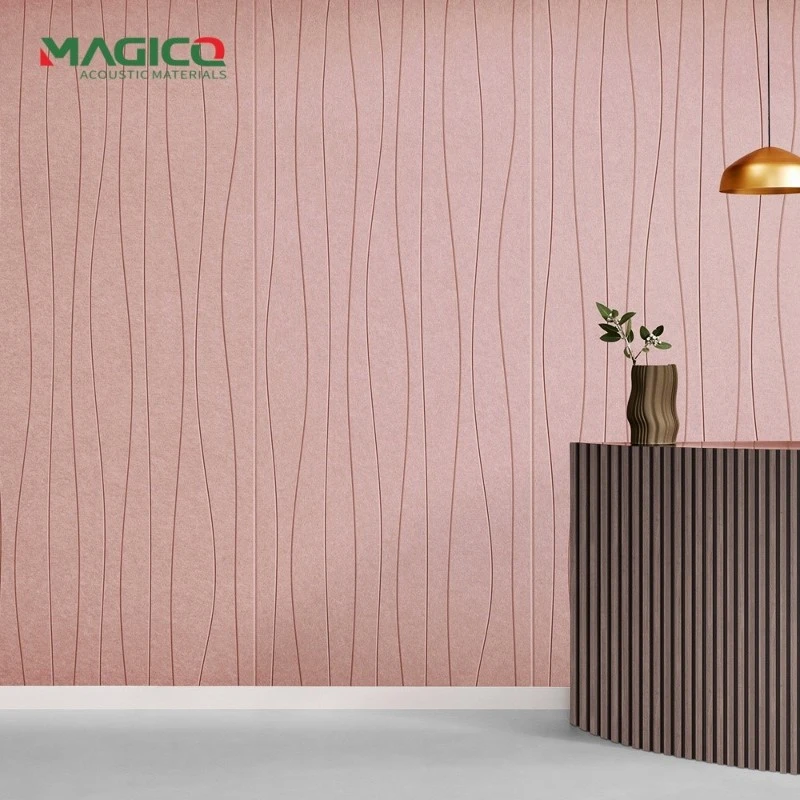
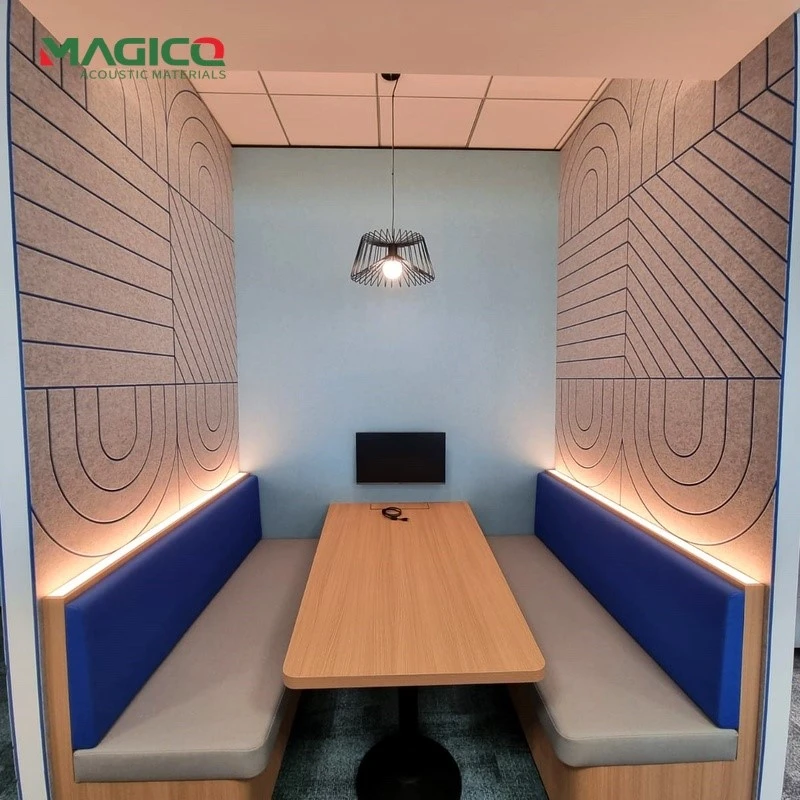
First, not all polyester felt is the same. The panels we make at our facility aren't the thin, stiff felt you'd use for a craft project; they're dense, multi-layered materials made from entangled polyester fibers. Those tiny, messy, crisscrossed fibers create thousands of tiny air pockets throughout the panel. When sound waves pass through the surface of the panel, they get trapped in those pockets, and the friction between the vibrating air molecules and the fibers turns that vibration into heat. That's absorption at its core, and that's why polyester works so well. Unlike hard, smooth surfaces like concrete or glass, which reflect most sound, or solid wood, which only absorbs a little, felt's porous, fibrous structure is perfect for catching those waves.
A lot of testing backs this up too. Acoustic engineers use a specific measurement called Noise Reduction Coefficient (NRC) to rate how much sound a material absorbs. NRC ranges from 0 (absorbs no sound, perfect reflector) to 1.0 (absorbs all sound, no reflection). High-quality polyester felt panels typically have an NRC of 0.7 to 0.9-meaning they absorb 70 to 90 percent of the sound that hits them. That's comparable to many fiberglass panels, and it's way better than most decorative wall materials like painted drywall or ceramic tile, which have NRCs of 0.1 to 0.3. But there's a catch here: the NRC test is done in a lab with panels that have an air gap behind them, which makes a big difference in real-world performance. If you hang a polyester felt panel flat against a wall with no space behind it, the absorption drops a little, because the air gap amplifies low-frequency sound like bass or deep rumble by letting the waves bounce back and forth within that space, giving the material more chances to absorb the vibration.
Wait, you might be thinking-what about PET felt? I get this question all the time, because a lot of people see the term "PET" and assume it's a different material entirely. In case you're new to the acronym, PET stands for polyethylene terephthalate, the same plastic used for water bottles and food containers. Our PET felt acoustic panels are made from 100% recycled PET bottles, which makes them a huge sustainable win-over 100 bottles go into a single 4x8 panel. But does being made from recycled plastic change their sound absorption? The short answer is no, not really. The manufacturing process turns those plastic bottles into tiny, uniform polyester fibers that are entangled the same way as virgin polyester, so the acoustic properties stay consistent. You can learn more about the specifics of how PET felt panels perform on our site, but at the end of the day, their NRC ratings are on par with virgin polyester panels because the core structure is the same.
That brings me to a common misconception: polyester felt is only good for high-frequency sound, like voices or bird chirps. Low-frequency sound-think bass in music, traffic rumble, or the low thrum of a HVAC system-tends to pass through many porous materials, right? Not polyester felt, at least not when it's the right thickness. Standard commercial panels are ½ inch thick, but for low-frequency absorption, we recommend panels that are at least 1 inch thick. For even better performance, pairing panels with that air gap I mentioned earlier makes a huge difference. I've seen this in action: a small café I supplied panels to tried ½-inch panels flat against their cinder block walls, and while the chatter was less echoey, the low hum from the kitchen overhead fans was still noticeable. Once they added 1-inch PET felt panels with a 3-inch air gap behind them, that low rumble practically disappeared, and the overall space felt much quieter.
Another thing I hear a lot: "Polyester felt panels are just for walls." No, they work for so many other spaces, and that's where our line of polyester fiber acoustic desk panels comes in. These smaller panels are designed to hang above a desk or workspace to reduce sound that bounces off nearby surfaces, which is perfect for open offices where conversations across cubicles can get loud. We've had remote workers and freelancers buy them for their home offices too, to cut out street noise or the sound of a TV in another room. They're easy to install, lightweight, and come in hundreds of colors, so they don't look like the clunky gray fiberglass panels you might remember from old school auditoriums.
But here's the thing: not all polyester felt panels are created equal. If you buy a cheap, thin panel from a big-box store that's only ¼ inch thick, made from loosely entangled fibers, it won't absorb nearly as much sound as our high-density polyester fiber sound absorbing panel. The quality of the fiber entanglement, the thickness of the panel, and the density all play a huge role. When I work with a new architect, I always start by asking what kind of space they're designing-an office, a recording studio, a daycare, a restaurant-because that dictates what size, density, and thickness of panel they need. For example, a daycare that has lots of running kids would benefit from thicker panels to absorb the higher-frequency screams and chatter, while a small home theater would need thicker panels with air gaps to tame low bass.
I should also address a common concern: are polyester felt panels fire-safe? A lot of people assume plastic materials are flammable, but high-quality polyester acoustic panels are treated with flame retardants that meet strict building codes, like Class A fire rating in the U.S. That means they're safe for use in offices, schools, and commercial buildings. Plus, they're moisture-resistant, mold-proof, and non-toxic-no formaldehyde or harsh chemicals, which is a big plus for spaces with kids, people with allergies, or anyone who wants a healthier indoor environment.
Let's circle back to the original question: Do polyester felt panels absorb sound? The answer is a resounding yes-when they're the right type. They're not a miracle fix for every sound problem, but they're one of the most effective, versatile, and eco-friendly options on the market right now. They work well for both new construction and retrofitting old spaces, they're easy to install, and they look way better than traditional acoustic materials. Whether you're dealing with echo in a small home office, rumble in a large open office, or chatter in a busy restaurant, polyester felt panels can make a huge difference.
If you're considering adding sound-absorbing panels to your space, take the time to think about your specific needs. How big is the room? What kind of sound is causing the most problem? What's your budget? And always make sure you're buying from a reputable supplier that can provide NRC ratings and fire safety information. For me, as someone who's been in this industry for years, seeing a customer walk into a space we outfitted and notice how much quieter it feels-without sacrificing style-is what makes the work worth it.
At the end of the day, polyester felt panels aren't just a trendy alternative to fiberglass. They're a proven, effective sound absorption solution that combines performance, sustainability, and style. If you're ready to learn more about which panels are right for your space, or to ask about custom sizing or colors, feel free to reach out to our team. We can help you navigate the different options, from our standard Polyester Sound Absorbing Panels to our custom-sized PET Acoustic Panels for any project. No question is too small, whether you're a first-time DIYer or a seasoned architect working on a large commercial build.
References
- Acoustical Society of America. (2018). Sound Absorption in Porous Materials. Journal of the Acoustical Society of America, 144(3), 1789–1802.
- National Research Council Canada. (2020). Eco-Acoustic Materials: Performance and Applications. NRCC Publication No. 58472.
- ASTM International. (2019). Standard Test Method for Sound Absorption Coefficient and Sound Transmission Loss of Acoustical Materials in a Reverberation Room (ASTM C423-19).
- U.S. Green Building Council. (2021). LEED Credit: Indoor Environmental Quality, Acoustic Performance. LEED v4.1 Operations and Maintenance Guide.